
A familiar Thai dish isn’t automatically made without MSG; its preparation matters more than its name. When looking for Thai food with no MSG in Toronto, distinguish a dish’s traditional ingredients from the seasonings used to prepare it. A menu description introduces a dish, but doesn’t tell you everything about how it’s seasoned.
Choosing a meal to suit your preferences needn’t mean missing out on fragrant herbs, tangy sauces, rich curries and lively street-food flavours. Toronto’s Thai food scene offers everything from casual meals to fine dining, with classic dishes to explore. This guide explains how to approach a no-MSG preference and introduces the flavours behind Thai curries, noodles and street-food favourites. You’ll also get a taste of Toronto’s local scene and learn how a made-from-scratch Thai meal can bring its own character.
Key Takeaways
- Learn how to distinguish a no-MSG claim from a no-added-MSG claim when exploring Toronto Thai menus.
- Recognize classic flavours in Pad Thai, green curry, Massaman curry and Tom Yum soup.
- Get a feel for Toronto’s Thai food scene, from casual street-food spots to high-end dining.
- Know what details about a dish’s seasoning and preparation matter when you’re choosing a meal.
- Explore dine-in, takeout, delivery and catering options for enjoying Thai food in the Beaches neighbourhood.
1. Thai restaurant in Toronto
Toronto offers Thai restaurants across neighbourhoods, but a restaurant’s name or menu doesn’t establish its MSG policy. Chiang Mai has a Danforth location at 353 Danforth Ave and a Liberty location at 171 E Liberty St Unit 144. Khao San Road is at 11 Charlotte Street. These addresses give diners concrete starting points for exploring different parts of the city.
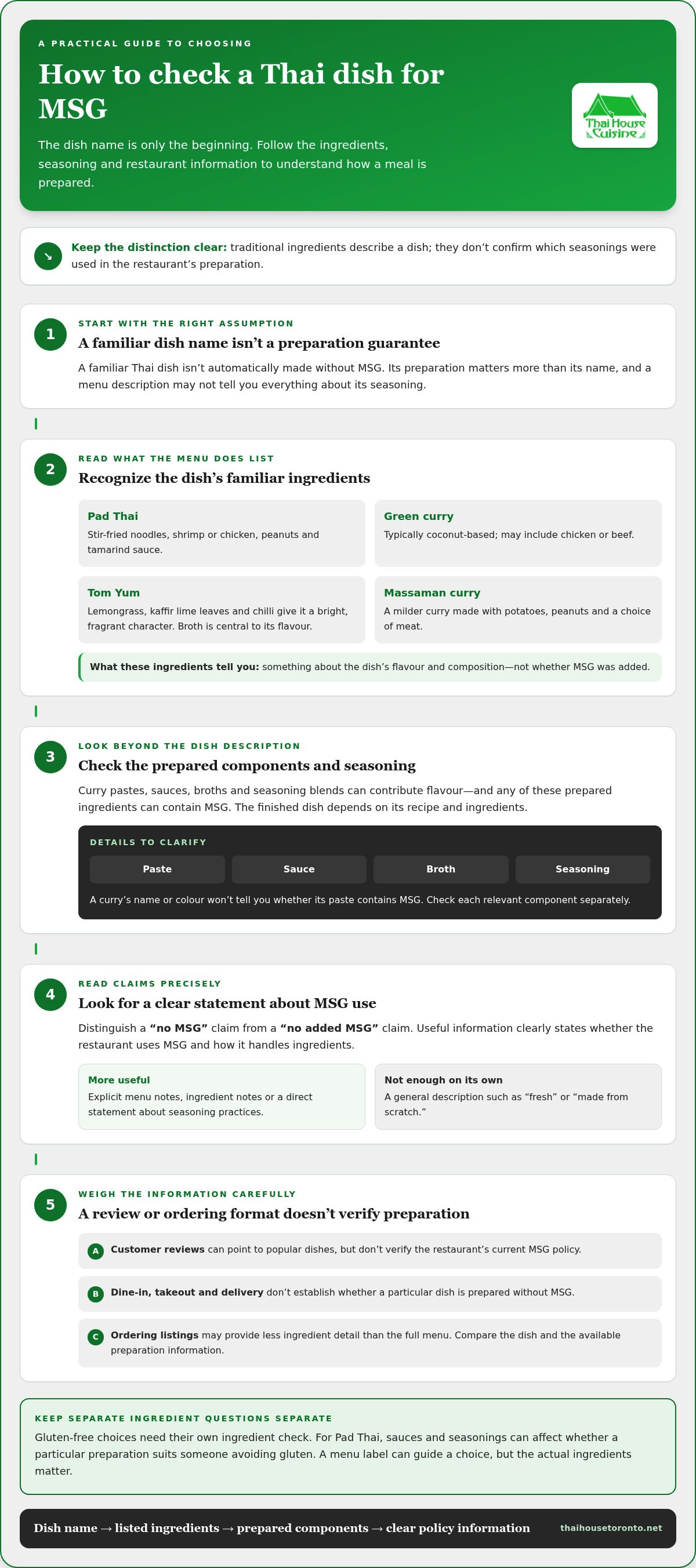
Which Toronto Thai restaurants have no-MSG policies? A policy is verifiable when a restaurant clearly states whether it uses MSG and how it handles ingredients. A general description such as “fresh” or “made from scratch” doesn’t answer that question. Menus, ingredient notes and direct statements about seasoning practices are more useful than recommendations alone.
Which Toronto restaurants offer MSG-free choices for dine-in, takeout and delivery? The service format doesn’t establish whether a particular dish is prepared without MSG. Compare the dish and its preparation across menus and ordering channels. A takeout listing, for example, may provide less ingredient detail than the full menu.
Can Thai curry pastes, sauces, broths or seasoning blends contain MSG? Any of these prepared ingredients can contribute flavour, so the finished dish depends on its recipe and ingredients. A curry’s name or colour won’t tell you whether its paste contains MSG. For a useful answer, ask about the dish’s paste, sauce, broth and seasoning separately.
Customer reviews can help identify popular dishes at a Toronto restaurant, but they don’t verify its current MSG policy. A review may describe one meal or visit, while a menu statement reflects the restaurant’s published information. Treat allergen details with similar care: look for explicit menu notes and distinguish an ingredient listing from a broader assurance about preparation.
Gluten-free choices require a separate ingredient check. Pad Thai commonly includes noodles, shrimp or chicken, peanuts and tamarind sauce, while sauces and seasonings can affect whether a particular preparation suits someone avoiding gluten. A menu label can guide your choice, but the dish’s actual ingredients matter. Name the dish and ask about its sauce and seasoning.
For practical restaurant recommendations, start with location and dish, then assess the information available. A diner near the Danforth can use Chiang Mai’s 353 Danforth Ave address as a neighbourhood reference; someone near Charlotte Street can locate Khao San Road at number 11. For dine-in, takeout or delivery, compare the listed dishes and available ingredient information before choosing. This turns a city-wide search into a focused decision, without mistaking a restaurant listing or customer review for proof of a no-MSG policy.
2. Thai curries, noodles, and street-food classics
Thai cooking builds flavour with ingredients that are easy to recognize. Pad Thai commonly combines stir-fried noodles, shrimp or chicken, peanuts and tamarind sauce. The sauce and the way the ingredients are cooked together create its sweet-sour balance. Those familiar components describe the dish, but don’t reveal every seasoning used in a restaurant’s preparation.
Toronto menus often feature red curry and Pad Thai as familiar favourites. Thai green curry typically has a coconut base and may include chicken or beef. Coconut adds richness, while curry paste brings aromatic depth and heat. The protein changes the dish’s character, but doesn’t indicate whether MSG was added.
Tom Yum has a different profile: lemongrass, kaffir lime leaves and chili give the soup its bright, fragrant character. Broth is central to its flavour, so the soup’s name alone can’t establish how it’s seasoned. Street-food classics also show how Thai cooking balances sour, savoury, sweet and spicy notes. Ingredients and preparation matter more than a dish’s category.
Massaman curry is a milder Thai curry made with potatoes, peanuts and a choice of meat. Its gently spiced, hearty ingredients distinguish it from sharper, more aromatic green curry. Red curry combines curry paste with coconut richness in another way. For all these dishes, traditional ingredients don’t prove whether a restaurant has added MSG.
Which Toronto Thai dishes commonly contain added MSG, and which are less likely to? The dish descriptions available here don’t identify any specific curry, noodle dish or soup as more or less likely to contain added MSG. Pad Thai, green curry, Tom Yum and Massaman curry all depend on their preparation, sauces, broth or paste.
When reading a menu, separate the dish name from its seasoning. Note whether a curry includes coconut, which proteins are offered and whether a soup comes with broth. Then distinguish those listed ingredients from seasonings and prepared sauces. This keeps your decision grounded in the actual recipe, rather than assumptions about authentic Thai cooking or street-food traditions.
Toronto’s Thai dishes offer plenty to explore, from Pad Thai’s tamarind tang to Tom Yum’s herbal lift. Compare menu descriptions with the flavours you enjoy, and remember that a classic dish name alone doesn’t confirm its seasoning. The same curry can taste different across restaurants because cooks use their own ingredients and preparation methods.
That report offers a snapshot of one participant’s experience, not a current menu quote or a guide to how dishes are seasoned. Cost alone can’t show whether a preparation includes added MSG, or how a restaurant makes its sauce, curry paste or broth. For ingredient questions, the menu description or a direct question to the restaurant is more useful than price.
4. Toronto's Thai food scene
Toronto’s Thai food scene includes casual street-food restaurants and high-end dining. That range gives diners different ways to experience Thai cooking, from a quick, focused meal to a more formal restaurant visit. The setting shapes the pace and presentation; the dishes and their preparation bring the flavour. A restaurant’s style alone doesn’t tell you how it seasons a particular dish.
For a street-food-style meal, start with the menu and identify what you’re craving. A noodle dish, curry or soup is a more useful starting point than a broad label such as “Thai.” Then check the details listed for that dish, including its sauce, broth, protein and accompaniments. These specifics help you compare menus and understand what each restaurant describes.
High-end dining offers a different setting for exploring Thai food. Menu descriptions may focus more on ingredients, presentation or the restaurant’s interpretation of a dish. Read the wording closely: “modern Thai” describes an approach or style, not a standard recipe or a statement about seasoning. A polished description can set expectations, but it doesn’t explain every ingredient.
Toronto’s variety also makes neighbourhood and occasion useful filters. First decide whether you want a casual street-food atmosphere or a more formal meal. Then narrow your choices by the dish you’re craving, such as a noodle plate for a hearty meal or soup for a broth-based option. Finally, read the dish details instead of assuming that two restaurants prepare the same item identically.
For diners seeking Thai food with no MSG in Toronto, the city’s variety of restaurant styles isn’t a shortcut to a clear answer. Casual and high-end menus may describe dishes differently, but style isn’t evidence of an ingredient policy. Focus on information about the specific preparation. The named dish, its listed components and a clear statement about seasoning are more useful than atmosphere or presentation.
Explore Toronto’s Thai food scene with curiosity and a clear preference in mind. Choose a setting, select a dish, then compare the menu details. A street-food restaurant may suit an informal meal, while high-end dining may fit a more considered occasion. Either way, the menu tells you what the restaurant highlights; ingredients and preparation determine the finished dish.
4. Which Thai restaurants in Toronto advertise no MSG or no added MSG?
A restaurant has a no-MSG policy only if it makes that claim clearly. “No added MSG” refers to an added ingredient, while “no MSG” may be interpreted more broadly. The wording matters. A general claim about fresh cooking, authentic recipes or house-made sauces doesn’t answer whether MSG is used.
Toronto examples with known addresses include Chiang Mai at 353 Danforth Ave and Khao San Road at 11 Charlotte Street. Those locations help identify restaurants, but an address or dish listing isn’t evidence of an MSG policy. Treat a restaurant as advertising a policy when its own menu or other public statement explicitly describes its MSG use.
Read the exact wording rather than relying on a search-result snippet. Check whether the statement applies to every dish, selected dishes or only one preparation. “No added MSG” doesn’t necessarily describe every ingredient in a sauce, broth or seasoning blend. Nor should a claim about one menu item be assumed to cover the whole menu.
Use this simple reading process:
- Find the claim: Identify a direct statement about MSG on the restaurant’s menu or public information.
- Check its scope: Note whether it applies to all dishes, selected options or one named dish.
- Read the qualifier: Separate “no MSG” from “no added MSG,” which may describe different things.
- Match the dish: Compare the wording with the curry, noodle dish or soup you intend to order.
Customer reviews can point to dishes people enjoyed, but they reflect individual experiences. They don’t establish a restaurant-wide policy or verify how a dish is prepared today. Similarly, “no MSG” in a review may refer to one order or visit, or to the reviewer’s understanding. A direct statement from the restaurant provides clearer information about its position.
For example, a Pad Thai description may list noodles, protein and tamarind sauce without disclosing every seasoning used. The same applies to curry paste and soup broth. Read any menu claim alongside the named dish, and don’t treat a traditional recipe description as proof of an MSG policy.
When comparing Thai restaurants in Toronto, look for explicit wording tied to the restaurant and the dish. Chiang Mai’s Danforth address and Khao San Road’s Charlotte Street address help locate those restaurants, but they aren’t endorsements or evidence of an MSG policy. A clear claim, its precise qualifier and its scope are what make an advertised policy meaningful.
5. Which Toronto Thai restaurants confirm they can prepare dishes without MSG on request?
A restaurant confirms an MSG-free preparation when it clearly explains how it will make a specific dish. A menu that simply lists Pad Thai, green curry or Tom Yum doesn’t establish that the dish can be prepared without MSG. Look for a direct statement about the restaurant’s preparation rather than drawing conclusions from the dish name.
Separate three kinds of claims: a restaurant-wide “no MSG” policy, “no added MSG” in a dish, and a preparation made without MSG on request. Each means something different. “No added MSG,” for example, refers to an addition, while a request concerns the preparation of an individual order. The precise wording helps you understand what the restaurant is saying.
Ask a focused question about the dish you want. Name it, then ask whether its curry paste, sauce, broth and seasoning contain added MSG, and whether the kitchen can prepare it without adding MSG. For Pad Thai, ask about the sauce and seasonings; for Tom Yum, ask about the broth. Specific questions make for a more useful answer than a general question about Thai food.
Consider what counts as meaningful confirmation. It should identify the dish and address its preparation, not simply offer a broad assurance about fresh ingredients. An answer about one curry doesn’t automatically apply to noodles or soup. Likewise, a statement about dine-in preparation doesn’t necessarily describe takeout or delivery, where a dish is prepared and packed for a different service format.
Reviews mentioning Pad Thai or green curry can help you discover dishes diners enjoy, but they describe individual experiences. They don’t establish a restaurant’s current preparation practices. A menu description can help identify ingredients, while an explicit statement from the restaurant about a specific dish provides more direct information. Keep these kinds of evidence distinct when comparing Toronto options.
For a practical decision, note the dish and the ingredients you want clarified. Ask about the paste, sauce, broth or seasoning used in that dish. Then assess whether the answer addresses added MSG and the requested preparation. This keeps the conversation precise without assuming that every Thai restaurant uses the same recipe or seasoning approach.
For a meal without added MSG, look for a clear statement about the exact dish and its preparation. A broad menu label, familiar recipe or customer review can’t replace that detail. Apply the same careful reading to Pad Thai, curry and soup, and distinguish a general policy from a request about one order.
Chef Mo cooked three dishes on The Zoomer TV, but that alone does not confirm whether a Toronto restaurant can prepare a particular order without MSG. A Toronto forum participant said they had been living in Bangkok for 4 years; that personal experience also cannot establish a restaurant’s current ingredients or preparation options.
Treat those details as context, not confirmation. Ask the restaurant about the dish you plan to order, and rely on an answer that addresses whether it can be prepared without MSG.
Thai House Cuisine: Dine-in Thai Meals
Thai House Cuisine is a welcoming place to enjoy Thai comfort food in Toronto’s Beaches neighbourhood. Dine in for a relaxed restaurant experience, or choose takeout and delivery for a meal elsewhere. Lunch specials offer another way to enjoy Thai dishes, while catering brings those flavours to gatherings across Toronto and the GTA.
If you’re choosing a meal based on a no-MSG preference, focus on the specific dish and how it’s prepared. Thai House Cuisine offers dine-in, takeout, delivery and catering, whether you’re planning a restaurant visit, a meal at home or an event.
Visit Thai House Cuisine online to explore the restaurant and get in touch.
Choose Your Next Thai Meal
Plan your next meal by choosing the dish you’re craving, deciding how you’d like to enjoy it and stating your ingredient preference clearly. For Toronto diners looking for Thai food with no MSG, focusing on a particular dish makes the choice more practical. Let the flavours that draw you to Thai cooking guide you, from a bright, aromatic soup to a richly seasoned curry.
Thai House Cuisine offers dine-in meals, takeout and delivery, as well as catering for gatherings. Choose what suits your plans, whether you’re settling in for dinner or sharing a meal with others. A thoughtful dish choice can turn an ordinary meal into a welcome moment of discovery.
Enjoy exploring Toronto’s Thai food scene, one flavourful meal at a time.
Frequently Asked Questions
How can diners ask Toronto Thai restaurants about MSG and cross-contact?
Name the dish and ask whether its sauce, broth, paste or seasoning includes added MSG. If cross-contact matters to you, ask whether the kitchen uses shared pans, utensils or preparation surfaces. For example, ask about the specific curry you plan to order rather than requesting a general “MSG-free” meal. Clear, separate questions distinguish ingredients from kitchen handling practices and make the answer relevant to your order.
Which Toronto neighbourhoods have Thai restaurants that accommodate requests for no MSG?
Explore the Danforth, Liberty Village, the Charlotte Street area and the Beaches for Toronto Thai restaurant options. Chiang Mai has locations on Danforth Avenue and East Liberty Street, while Khao San Road is on Charlotte Street; Thai House Cuisine is in the Beaches. These neighbourhoods help narrow your search, but location alone doesn’t establish a restaurant’s approach. Focus on the specific dish and ask about its preparation when choosing where to dine.


