

A great green papaya salad isn’t defined by heat alone. An authentic papaya salad in Toronto balances lime’s sharpness with sweetness, savoury depth and the crunch of fresh ingredients. Chiles, dried shrimp, peanuts and long beans each add a distinct note, and how they come together matters as much as what goes into the bowl.
If you love the lively contrast of sour, sweet and savoury, understanding that balance can make the dish even more satisfying to order. The salad should taste bright and layered, with spice complementing the other flavours rather than overwhelming them.
This guide explains how Toronto Thai restaurants prepare green papaya salad, what each ingredient contributes and how chefs adjust the flavour profile. You’ll also learn what to look for when choosing a version that suits your palate, whether you prefer a gentler chile warmth or a more pronounced kick.
Key Takeaways
- Learn what gives green papaya salad its crisp texture and how careful preparation helps preserve it.
- Understand how sour, sweet and savoury notes work together to create a balanced dressing.
- See how chiles, dried shrimp, peanuts and long beans each contribute a different layer of flavour.
- Find out how to communicate your preferred spice level when ordering papaya salad.
- Know what details to mention when asking for a traditional-style salad in Toronto.
Thai green papaya salad
- Select firm, unripe green papaya. Its pale flesh should be crisp enough to hold its shape after shredding and mixing. For authentic papaya salad in Toronto, ingredient quality begins with fruit that is still green, not soft or sweet like ripe papaya. Restaurants source green papaya through their produce suppliers, then assess each fruit for firmness before preparation. A firm papaya gives the salad its characteristic fresh crunch.
A recipe uses ¼ green papaya, about 9 ounces or 250 g, for a batch. The amount of usable flesh varies with the fruit, so cooks judge the prepared quantity rather than relying on the whole fruit’s size alone.
- Peel and shred the flesh into manageable strands. Restaurants remove the green skin, then cut or shred the pale flesh into crisp strips. One recipe recommends pieces about 3 inches long, which are easy to mix and pick up. Consistent strands help dressing cling across the salad instead of collecting only at the bottom.
A recipe uses 2 cups of shredded green papaya. This gives cooks a practical measure for balancing the fruit with dressing and other ingredients. The strands should stay distinct, not become crushed or watery during preparation.
- Keep preparation close to service. Shredded papaya can be refrigerated in an airtight container for up to 24 hours before the salad is made. This gives a restaurant flexibility while protecting the papaya’s crisp texture. Once dressing is added, the fruit begins to soften, so cooks mix the salad near the time it will be served.
Chef Nuit Regular says papaya salad can be made in less than ten minutes after picking the fruit. That short preparation window reflects the dish’s fresh, direct approach: prepare the ingredients, combine them, then serve without a long wait.
- Use a mortar and pestle to bring the ingredients together. A traditional som tam method uses a clay or wooden mortar and a wooden pestle. The cook gently pounds selected ingredients, then folds in the papaya so the strands take on flavour without losing all their crunch. The goal is an evenly dressed salad, not a paste.
That distinction matters: hard pounding can bruise the papaya and dull its lively texture. A careful cook controls the force and mixes until the strands carry the dressing and accompanying ingredients throughout.
- Finish and serve while the texture is fresh. After mixing, the cook checks that the dressing coats the strands and each serving has a balance of papaya and accompanying ingredients. Som tam is best enjoyed soon after preparation because the papaya softens as it sits in the dressing.
For takeout, the time between preparation and eating can affect the crunch. A fresh salad should still have distinct strands when served, with dressing distributed rather than pooled. Careful shredding, mixing and timing all contribute to the finished dish.
Balancing sour, sweet, and savoury flavours
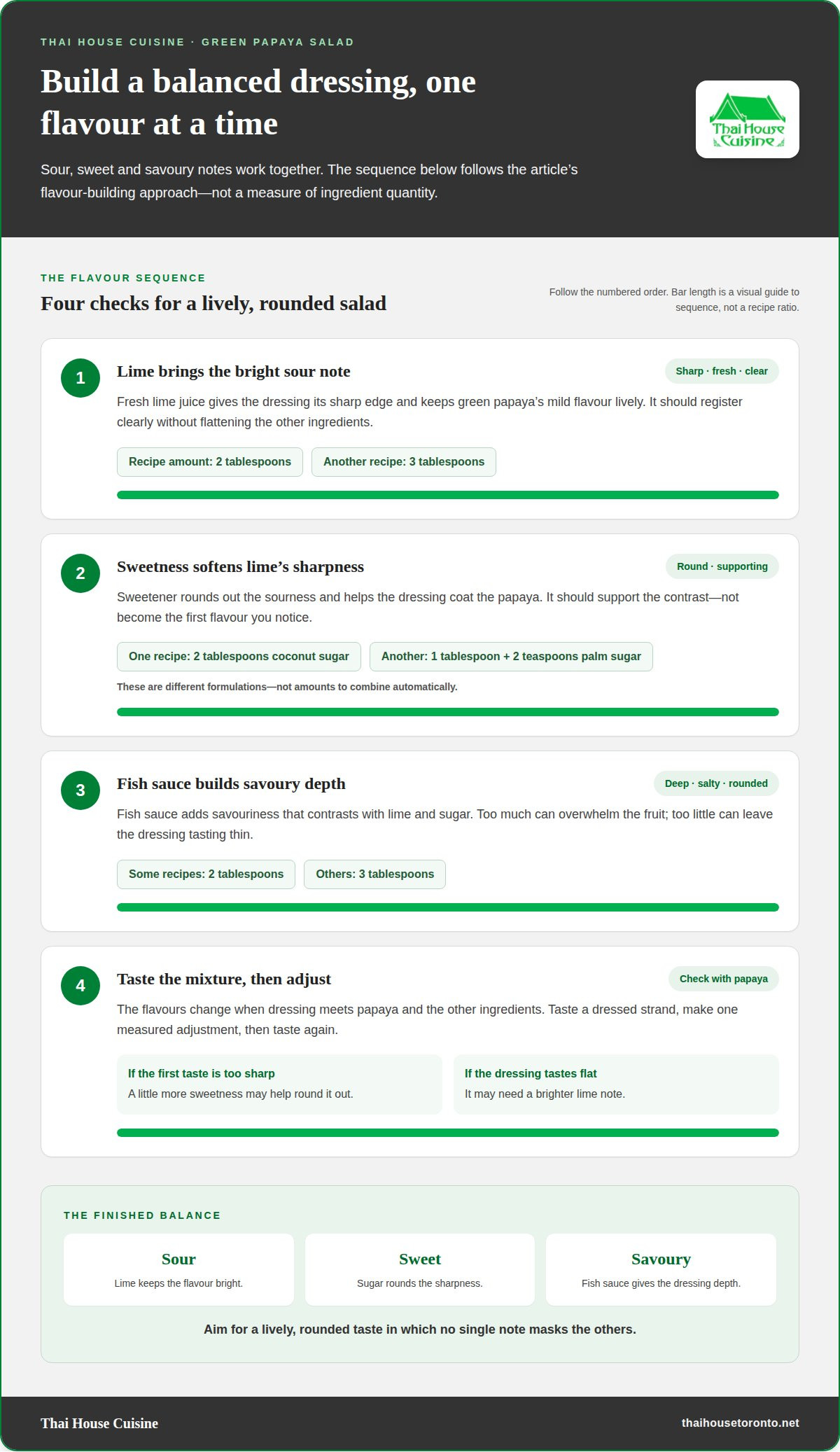
- Start with lime for a bright, clear sour note. Fresh lime juice gives the dressing its sharp edge and keeps the green papaya’s mild flavour lively. Recipes use different amounts, including 2 tablespoons or 3 tablespoons, so the balance depends on the rest of the dressing. A cook considers how much fish sauce and sugar will join the lime before settling the final taste.
That sequence matters. Lime should register clearly, but it shouldn’t flatten the other ingredients. In a Toronto restaurant kitchen, tasting the dressing before mixing it through the papaya helps catch an overly sharp or muted result. The finished salad should taste balanced across the strands, not only in a mouthful of dressing.
- Add sweetness to soften the lime’s sharpness. A recipe may use 2 tablespoons of coconut sugar, while another calls for 1 tablespoon plus 2 teaspoons of palm sugar. These are different formulations, not quantities to combine automatically. The sweetener rounds out the sourness and helps the dressing coat the papaya with a fuller flavour.
Sweetness should support, not dominate, the salad. A cook works the sugar into the dressing, then tastes again with the sour ingredient present. If sweetness is the first flavour noticed, the balance shifts away from the lively contrast that makes som tam distinctive.
- Build savouriness with fish sauce. Some recipes use 2 tablespoons, while others use 3 tablespoons. Fish sauce adds a deep, salty savouriness that contrasts with lime and sugar. Its role is more than saltiness: it gives the dressing a rounded base that carries through the crisp papaya.
Lime juice and fish sauce vary between recipes, so cooks adjust them in relation to each other. Too much fish sauce can overwhelm the fruit; too little can leave the dressing tasting thin. Tasting a small amount with papaya gives a more useful impression than assessing the dressing alone.
- Taste the complete mixture, then make small adjustments. Sour, sweet and savoury notes change once they meet the papaya and other ingredients. A cook checks a strand with dressing, rather than relying only on a spoonful of sauce. The flavour should feel lively and rounded, with no single element masking the others.
For example, a sharp first taste may call for a little more sweetness, while a flat dressing may need a brighter lime note. A savoury finish can become more pronounced after mixing. Make one measured adjustment at a time, then taste again before serving. This careful final check helps keep the dressing cohesive from the first bite to the last.
Chiles, dried shrimp, peanuts, and long beans
- Use fresh Thai chiles to set the heat. Recipes call for 1 to 3 bird’s eye chilies, while another uses 2 to 3 fresh Thai chiles. These ranges show how cooks can adjust the heat to suit the salad and the people eating it. A smaller amount brings a gentle warmth; more chiles make the spice more prominent.
Chiles contribute more than heat. When gently pounded with other ingredients, they release their juices into the dressing, spreading warmth through the papaya instead of leaving it to whole pieces of chile. A careful cook builds heat gradually and tastes the complete mixture before adding more.
- Add dried shrimp for savoury depth. One recipe uses 1 tablespoon, while another calls for ¼ cup of large dried shrimp. Those amounts belong to different recipes and shouldn’t be combined as a single standard. Dried shrimp add a concentrated seafood flavour that gives the salad more depth alongside its fresh, crisp ingredients.
Size affects how the shrimp appear in each bite. Large dried shrimp are more noticeable, while a smaller quantity can season the mixture without dominating it. A cook distributes them throughout the salad, so the savoury taste complements the papaya instead of gathering in one spot.
- Finish with roasted peanuts for crunch. A recipe may use 2 tablespoons of roasted, unsalted peanuts, divided, or ¼ cup of unsalted roasted peanuts. The amount changes between recipes, but the purpose remains clear: peanuts add a toasted flavour and a crisp contrast to the papaya’s tender strands.
Peanuts can be mixed through the salad, with a few reserved for the finish. This distributes their flavour while keeping some pieces crisp on top. Unsalted peanuts also let the dressing remain the main source of seasoning, rather than adding competing saltiness.
- Cut long beans into pieces that mix evenly. One recipe uses 3 yard-long beans cut into 1-inch pieces. Another calls for 2 long beans cut into 2-inch pieces. Both give the salad firm, green pieces that contrast with shredded papaya and hold their shape during mixing.
Long beans provide a fresh, earthy bite. Smaller pieces spread through more mouthfuls, while larger pieces stand out distinctly. A cook folds them in carefully and checks that the serving brings papaya, beans, shrimp and peanuts together.
- Bring the four ingredients together with restraint. Chiles supply heat, dried shrimp bring savoury depth, peanuts add toasted crunch, and long beans contribute a firm bite. Each plays a different role. The amounts vary by recipe, so the cook balances them against the salad’s size and desired character rather than treating one set of measurements as universal.
The ingredients should remain recognizable in each serving. Too many peanuts can mask other textures, while concentrated chile or shrimp can dominate a bite. Even distribution lets the contrasting ingredients support the papaya, creating varied texture and flavour throughout.
How spicy is papaya salad at Toronto restaurants, and can you choose the heat level?
- Expect chile heat to vary by recipe. Papaya salad doesn’t have one standard spice level across Toronto restaurants. Recipes may call for 1 to 3 fresh bird’s eye chilies, while another uses 2 to 3 fresh Thai chiles. Those ranges show how the amount can change; they aren’t a shared mild-to-hot scale. A dish made with fewer chiles will generally have less chile presence than one made with more.
When ordering, describe whether you prefer mild, moderate or stronger chile heat. Stating the level you enjoy gives the kitchen clearer direction than saying only “not too spicy.”
- Describe your comfort with heat clearly. If you prefer gentle warmth, say you want the chile kept light. If you enjoy a noticeable burn, request a stronger chile presence. A specific comparison can help: explain whether you want warmth in the background or heat that stands out in each bite.
A recipe’s chile range doesn’t determine how every restaurant prepares its salad. The final intensity depends partly on how many chiles are used and how thoroughly they’re worked into the mixture. State your preference when ordering.
- Remember that preparation affects how heat is distributed. In som tam, chiles may be pounded with other ingredients before the papaya is mixed in. This releases chile flavour throughout the dressing, so heat can reach more than the occasional bite containing a whole chile. A salad with chiles distributed through the dressing may taste more consistently hot.
The number of chiles is only one clue. Their size and preparation also influence how prominent they seem in the finished salad. Since recipes vary rather than follow a universal heat rating, asking for your preferred intensity is more useful than relying on a number alone.
- Choose a practical request for your first order. If you’re unsure, ask for a gentler chile presence rather than the strongest version. That lets you enjoy the lime, sweetness and savoury notes alongside the spice. If you already know you like chile heat, describe that preference directly.
For shared meals, consider the people eating the salad. One person’s comfortable level may feel intense to someone else. A clear request such as “light chile heat” or “make the chiles prominent” communicates more than a vague instruction. The recipe examples of 1 to 3 bird’s eye chilies or 2 to 3 Thai chiles illustrate variation, not a guaranteed restaurant scale.
What should I ask for to get papaya salad prepared authentically in Toronto?
- Name the dish and its main ingredient. Ask for Thai green papaya salad, also known as som tam. Naming the dish helps distinguish it from salads made with ripe papaya or other vegetables. Green papaya should be firm and shredded into crisp strands, not soft, sweet chunks. You can describe the texture you expect: fresh, crunchy papaya mixed with dressing and complementary ingredients.
For a Toronto order, be specific. “Thai green papaya salad with crisp shredded papaya” communicates more than simply asking for a papaya salad.
- Describe the flavour balance you enjoy. Lime brings sourness, sugar adds sweetness, and fish sauce contributes savoury depth. Ask for a bright, balanced dressing if you want all three notes to come through. If you prefer one flavour to stand out, say so plainly, such as “a little more sour” or “less sweet.”
These instructions describe the taste you want without asking the kitchen to abandon som tam’s character. A clear preference gives the cook useful direction for adjusting the finished salad.
- State your chile preference in direct terms. Ask for light, moderate or prominent chile heat, then clarify what that means to you. For example, request warmth in the background or a distinctly spicy bite. Recipes may use 1 to 3 bird’s eye chilies or 2 to 3 Thai chiles, but those amounts aren’t a universal restaurant heat scale.
Specific wording helps communicate your comfort level. “Keep the chile light” gives clearer guidance than “not too spicy,” especially if you’re sharing the salad with someone who prefers less heat.
- Ask which traditional ingredients are included. Dried shrimp, roasted peanuts and long beans each add a different taste or texture. If those details matter to you, ask whether the salad includes them. You can also mention a preference, such as wanting the peanuts distributed through the salad or a noticeable crunch from the beans.
Recipes vary: one may include 1 tablespoon of dried shrimp, while another uses ¼ cup. Those examples show why asking about ingredients can be more helpful than assuming every preparation uses identical amounts.
- Choose how you’ll enjoy the salad. Som tam is best eaten soon after it’s dressed because the papaya softens as it sits. Dine in to enjoy the salad soon after preparation. For takeout, consider the travel time and eat it promptly to appreciate its crisp texture.
A clear request about green papaya, flavour, chile heat and ingredients helps you describe the experience you want. A few precise details make your order easier to understand and help the salad suit your preferences.
Thai House Cuisine
Thai House Cuisine serves Thai comfort food in Toronto’s Beaches, with dine-in and takeout options. Its chefs prepare dishes inspired by family recipes and use fresh local ingredients. If you’re exploring papaya salad, the guidance in this article can help you describe your preferred balance of sourness, sweetness and chile heat when ordering.
Choose dine-in Thai meals for a relaxed restaurant experience, or takeout and delivery when you’d rather enjoy Thai food elsewhere. Thai food catering and lunch specials offer other ways to enjoy Thai flavours at a gathering or midday meal.
Contact Thai House Cuisine to discuss your next Thai meal.
Make your next Thai meal a flavourful one
Turn your curiosity into a meal you can enjoy at your own pace. When choosing an authentic papaya salad in Toronto, tell the restaurant what kind of flavour experience you enjoy, then let the fresh ingredients shine. It’s a simple way to make the dish feel personal, whether you’re ordering for yourself or sharing Thai food with others.
Thai House Cuisine offers dine-in Thai meals, takeout and delivery, and Thai food catering. Choose the setting that suits your plans and enjoy a thoughtfully prepared Thai meal.
May your next meal bring bright flavours, good company and a fresh appreciation for Thai cooking.
Frequently Asked Questions
Where can I find authentic Thai papaya salad in Toronto?
Thai House Cuisine in Toronto’s Beaches serves Seafood Papaya Salad. The menu lists green papaya, tomato, green bean, peanut, garlic, chilli and lime juice, and describes the dish as medium-hot. For authentic papaya salad in Toronto, this gives you a concrete starting point: consider whether seafood and that heat level suit your meal. Thai House also serves Toronto’s East End, including Danforth and Leslieville.
Which Toronto restaurants serve authentic Isan-style som tam?
Thai House Cuisine serves a Thai Seafood Papaya Salad, prepared with seafood, green papaya, tomato, green bean, peanut, garlic, chilli and lime juice. The menu does not describe it as Isan-style som tam. If you’re seeking that specific regional style, distinguish it from a general Thai papaya salad description rather than assuming the dishes are identical.
What ingredients are used in traditional Thai papaya salad?
Traditional Thai papaya salad centres on green papaya, with ingredients such as lime, fish sauce, sugar, chiles and garlic shaping its dressing. Recipes may also include tomatoes, dried shrimp, peanuts and long beans. Ingredients differ by preparation. For example, Thai House Cuisine’s Seafood Papaya Salad lists seafood, green papaya, tomato, green bean, peanut, garlic, chilli and lime juice. That menu version adds seafood to the familiar mix.
Which Toronto restaurants have the best reviews for papaya salad?
There isn’t enough comparable review information here to rank Toronto restaurants by papaya salad reviews. Thai House Cuisine is one local option, with Seafood Papaya Salad on its menu. To assess feedback, focus on recent comments that discuss the salad itself, such as its texture, seasoning or how well it suits the reviewer’s preferred heat level. General restaurant ratings may not reflect diners’ experiences with this particular dish.


