
Could a dish that sounds naturally gluten-free still contain a sauce or seasoning you wouldn’t expect? If you’re searching for gluten-free Thai food The Beaches has to offer, a familiar dish name is only a starting point. The full ingredient list and how a meal is prepared matter, too.
Dietary notes can help you narrow your choices, but they don’t always explain every sauce or preparation step. A request for gluten-free sauce, for example, doesn’t automatically tell you whether the rest of a dish suits your needs. This guide shows you how to read menu descriptions, compare dish components and communicate your requirements when choosing dine-in, takeout or delivery in Toronto’s Beaches neighbourhood.
Thai House Cuisine serves regional Thai dishes inspired by family recipes, with dine-in, takeout and delivery available. Whether you’re in The Beaches, Danforth, Leslieville, nearby Scarborough or Toronto’s East End, the same careful approach can help you assess menu information and decide what details matter to you.
Key Takeaways
- For gluten-free Thai food The Beaches diners can compare, look beyond dish names to sauces, seasonings, ingredients and preparation.
- Use menu descriptions as a starting point, not proof that every ingredient or cooking step meets your needs.
- When considering dishes such as Pad Thai or green curry, assess the components separately and note what the menu does not explain.
- Explain whether you avoid gluten generally or need to account for cross-contact, then choose the ordering format that suits your plans.
- Thai House Cuisine’s menu includes a note to request gluten-free sauce for Pad Thai. Treat it as information about the sauce request, not an assurance about the complete dish.
Gluten-Free Thai Food in The Beaches: Start With Your Dietary Needs
A Thai dish can feature rice, vegetables, meat or seafood and still include gluten through a sauce, seasoning or another ingredient. The main ingredients and a familiar dish name don’t establish whether the complete meal fits your needs. Consider both what goes into the dish and how it is prepared.
This distinction is useful when comparing menus around Toronto’s Beaches neighbourhood, Danforth, Leslieville, nearby Scarborough and the East End. Read menu wording for clues about ingredients and requests, but don’t treat a short dietary note as a full account of every ingredient or kitchen step.
Gluten avoidance and celiac disease are not interchangeable
Diners avoid gluten for different reasons, and their needs may differ. Some choose to avoid it as a personal preference; others may have a sensitivity or celiac disease. These situations are not interchangeable. Your own requirements determine how much information you need before choosing a meal. For general background on gluten-free diets and foods, see this Gluten-Free Diet Overview.
For someone with celiac disease, cross-contact deserves particular attention. Cross-contact occurs when gluten transfers to food through shared hands, utensils, cookware or surfaces. Even when a dish’s listed ingredients appear suitable, unintended transfer can matter. A menu description cannot establish how a dish was handled, so an ingredient list or gluten-free request should not be treated as proof of celiac suitability.
What a menu can, and cannot, tell you
Menu descriptions offer useful clues. They may name noodles, sauces, marinades or other components that deserve a closer look. But a dish name rarely lists every seasoning or preparation detail, and recipes can vary. Pad Thai and green curry, for example, should be assessed by their components rather than assumed to be gluten-free based on their names.
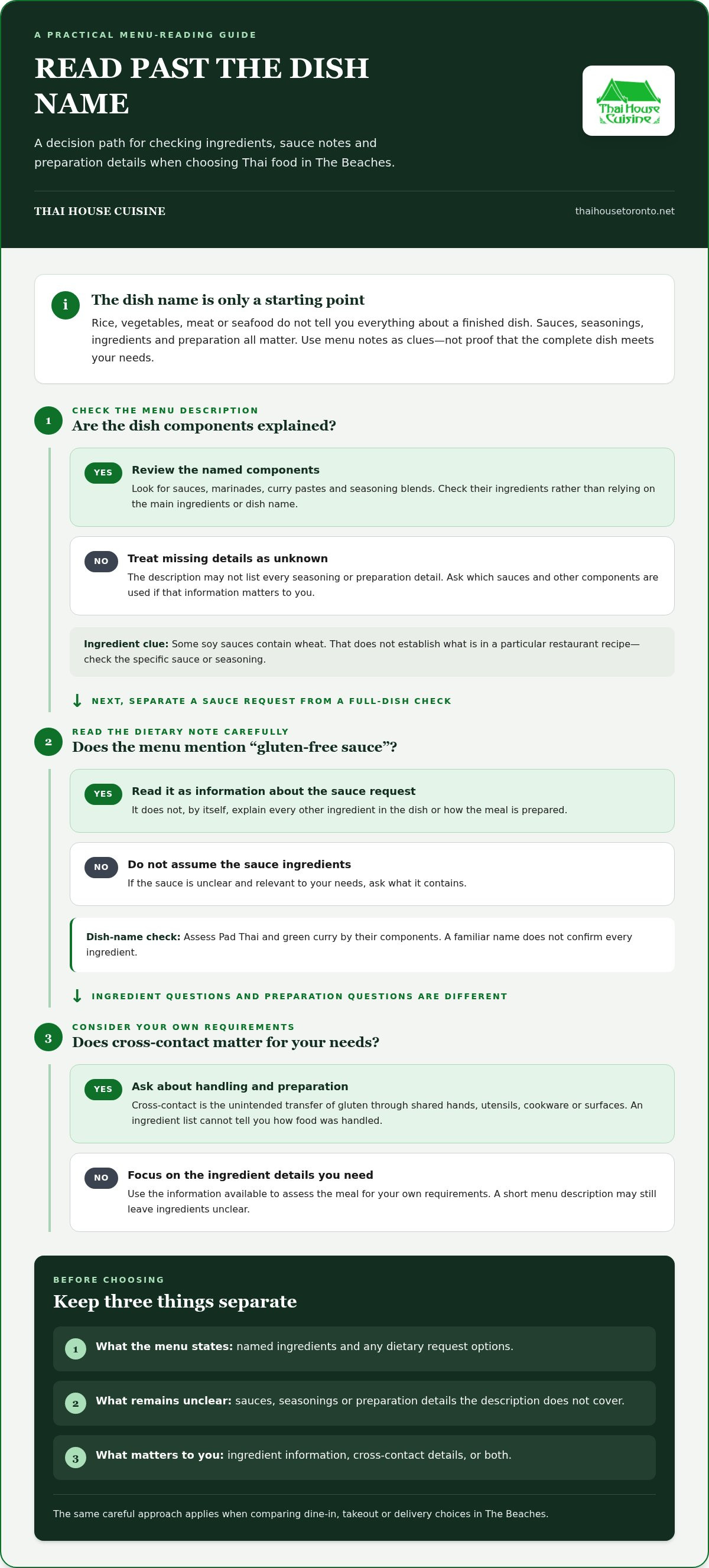
Read menu notes as a starting point. “Gluten-free sauce” tells you about the requested sauce, but it does not explain every other ingredient or address cross-contact during preparation. The same principle applies whether you’re viewing a printed menu or ordering online.
As you compare gluten-free Thai food The Beaches menus offer, keep your own needs at the centre. Separate what the menu states from what it leaves unanswered:
- What’s described: Note the named ingredients and any dietary request options.
- What’s unclear: Identify sauces, seasonings or preparation details the description does not cover.
- What matters to you: Decide whether ingredient information is enough for your needs or whether you also need to account for cross-contact.
This distinction makes menu browsing more practical: descriptions can help narrow your options, while specific information helps you assess the details that matter to you. Next, consider where gluten may appear in Thai sauces and seasonings.
Where Gluten Can Hide in Thai Food: Sauces, Seasonings, and Preparation
Once you’ve identified your own needs, look beyond a dish’s main ingredients. Rice, vegetables, meat or seafood may seem like straightforward choices, but sauces and seasonings can add components that aren’t obvious from a menu description. Marinades, curry pastes and seasoning blends also deserve ingredient-level attention. Recipes vary, so don’t assume every version of a dish uses the same ingredients.
Sauces and seasonings deserve a closer look
Soy sauce is one example to consider because some soy sauces contain wheat. That does not establish what’s in a particular restaurant recipe; it points to a useful ingredient question. Beyond Celiac explains more in its guide to Gluten in Soy Sauce and Alternatives. Other sauces, marinades or seasoning blends may also need a closer look when their ingredients aren’t clear.
A sauce can change how you assess an otherwise simple combination of rice, vegetables and protein. Curry pastes and prepared seasonings may contain several ingredients, so the dish name alone won’t tell you what’s in them. Focus on the specific sauce or blend rather than assuming an ingredient is present or absent based on a familiar Thai dish.
Ingredient checks and cross-contact answer different questions
Ingredient questions concern what goes into a recipe. Cross-contact is the unintended transfer of gluten to food during handling or preparation, such as through shared utensils or surfaces. These are separate considerations: an ingredient check can clarify a recipe, but it does not explain how the food was prepared.
The details you need may differ depending on whether you avoid gluten generally or need to account for celiac-related precautions. If cross-contact matters for your needs, state that clearly when placing your order and identify the preparation details that affect your decision. Keep your questions direct and specific.
A naturally gluten-free ingredient does not guarantee that the finished dish is gluten-free. Use that distinction to guide your next questions:
- Ask about ingredients: Which sauce, marinade, curry paste or seasoning blend is used?
- Clarify the request: Does a gluten-free sauce option refer only to the sauce, or to other parts of the dish as well?
- Discuss preparation: If cross-contact matters for your needs, ask about relevant handling and preparation details.
These questions turn a broad dietary note into a more useful conversation without making assumptions about a recipe or preparation method. For a local starting point, explore Thai House Cuisine’s Beaches restaurant information, then consider the specific details that matter for your meal.
How to Compare Gluten-Free Thai Menu Choices in The Beaches
A useful comparison breaks a dish into parts instead of treating its name as a dietary answer. Review the main ingredient, sauce, seasonings, garnish and preparation individually. Then distinguish what the menu actually says from what you still need to understand. This gives you a clearer basis for comparing gluten-free Thai food The Beaches offers against your own needs.
Compare a dish by its individual components
Pad Thai shows why details matter: noodles and sauce are separate components, and a note about requesting gluten-free sauce applies to the sauce. It does not automatically cover every part of the meal or explain how it was prepared. With green curry, consider the curry paste and any named accompaniments separately. These are dishes to assess, not claims that either option is suitable for every gluten-free diner.
Use this table as a menu-reading tool. “What the menu establishes” means only what its wording explicitly states, not an assurance about ingredients or preparation beyond that description.
| Dish to assess | Components to consider | Questions to consider | What the menu establishes |
|---|---|---|---|
| Pad Thai | Noodles, sauce, seasonings, garnish and preparation | What does the sauce request cover? Are other ingredients or preparation details relevant to your needs? | The Thai House online menu describes Pad Thai and includes a note to request gluten-free sauce. That note alone does not establish the suitability of the complete dish. |
| Green curry | Curry paste, sauce, accompanying ingredients and preparation | Which ingredients are named, and what details about the paste or preparation remain unclear? | A dish name by itself doesn’t establish the curry paste’s ingredients or how the dish is prepared. |
Use the menu description as a starting point
Menu wording can identify components worth reviewing, but a short description may not cover every seasoning, recipe detail or preparation step. Your threshold matters: someone avoiding gluten by preference may weigh the available information differently from someone who needs celiac-level precautions, including attention to cross-contact. Don’t read more into a menu note than it says.
As you compare options, mark each detail as stated or unanswered. For example, a sauce request is stated; whether it addresses all ingredients and preparation is a separate question. This simple distinction helps prevent a promising description from being mistaken for a complete answer.
Start with the Thai House online menu. Use its descriptions to identify details relevant to your order, compare dishes component by component, and decide what information you need to make an informed choice.
Ordering Gluten-Free Thai Food: A Practical Plan for Dining In or Takeout
A consistent ordering routine helps you carry your dietary needs from menu browsing through to the meal. For gluten-free Thai food The Beaches diners can order, use this sequence whether you plan to dine in or order for home in Toronto’s East End, Danforth, Leslieville or nearby Scarborough.
- Identify your needs. Decide how to describe your gluten restriction. State whether you avoid gluten generally or need precautions for celiac disease, including attention to cross-contact.
- Review the menu wording. Read the full description and note what it says about the dish, sauce or dietary request. Treat gaps as questions, not assumptions.
- Communicate clearly. State the restriction and its importance in plain language. Don’t assume a sauce substitution addresses every ingredient or preparation concern.
- Choose a service format. Decide whether dine-in, takeout or delivery suits your plans, then keep your dietary instructions connected to the order.
Communicate dietary needs clearly when placing an order
Be specific and concise. You might say, “I avoid gluten,” or “I need to avoid gluten, including cross-contact, because I have celiac disease.” Clear wording distinguishes a general preference from a stricter need. If you’re asking about a menu note such as a gluten-free sauce request, explain what you need to know about the rest of the dish, too.
Keep questions focused on the details that affect your decision. A sauce change does not, by itself, explain other ingredients or preparation. Don’t assume an accommodation or handling step. Use the information available to decide whether the choice suits your needs.
Choose a service format that suits your meal
Dine-in gives you the opportunity to communicate directly while ordering. Takeout and delivery are convenient when you’d rather enjoy a meal elsewhere, but depend on the instructions you provide with the order. No format is automatically safer. Whichever you choose, make your dietary request clear and include it in the online order notes where available.
For a sit-down meal in the neighbourhood, you can also explore Beaches dine-in reservations as part of planning your visit. Choose dine-in, takeout or delivery based on the occasion, and use the same careful approach to your dietary needs across formats.
Once you’ve reviewed the menu and identified what you need to communicate, the Thai House online menu is a practical place to compare dishes and note questions for your order.
Gluten-Free Thai Food at Thai House Cuisine in The Beaches
Thai House Cuisine serves Thai comfort food in Toronto’s Beaches neighbourhood. Thai chefs prepare regional dishes inspired by family recipes and made with fresh local ingredients. For diners exploring gluten-free Thai food The Beaches has to offer, the online menu provides a specific detail to consider, while the complete meal still needs to be assessed against each diner’s requirements.
What the Thai House menu tells diners
The Pad Thai menu description includes a note to request gluten-free sauce. It is useful information for placing an informed order, but it refers to the sauce request only. The note does not establish that every part of the dish meets a diner’s gluten-free needs, nor does it claim celiac-safe ingredients or preparation.
Read the wording carefully and separate what it states from what it does not explain. The menu can help you identify details to consider when ordering, while your own needs determine what else matters. Someone avoiding gluten generally may assess the available information differently from a diner who needs to account for cross-contact. Don’t treat a sauce note as a guarantee about the complete meal.
Review the Thai House online menu for current dish descriptions and note the details that matter to your order. Clear expectations help you make a considered choice without reading more into a menu note than it says.
Make your next local Thai meal simple
A practical approach is straightforward: review the menu, consider the whole dish rather than one ingredient or sauce, and state your dietary needs plainly when placing your order. If you need to avoid cross-contact, make that requirement clear too. This keeps the conversation focused on the details that matter to you without assuming a particular dish or preparation will suit everyone.
Choose the experience that fits your plans. Thai House Cuisine offers dine-in, takeout and delivery for a neighbourhood meal at the restaurant or at home. Whether you’re in The Beaches, Danforth, Leslieville, nearby Scarborough or elsewhere in Toronto’s East End, carry your dietary instructions through the ordering process and use the menu note as a starting point, not a safety assurance.
Explore the menu and plan your Thai House meal in The Beaches.
Make Your Next Thai Meal a More Informed Choice
Approach the menu with your own needs in mind, and let clear, specific communication guide your decision. A helpful dietary choice isn’t about finding a dish with the right-sounding name; it’s about having enough relevant information to decide what works for you. That’s a practical way to explore gluten-free Thai food The Beaches offers, whether you’re planning a relaxed meal out or ordering in.
Thai House Cuisine brings regional Thai cooking to the neighbourhood, with dishes prepared by Thai chefs using family recipes and fresh local ingredients. Choose dine-in, takeout, delivery or catering to suit the occasion, and explore the menu as you plan your meal in The Beaches, Danforth, Leslieville, nearby Scarborough or Toronto’s East End.
Choose your Thai House dining experience and explore the menu to plan your next local meal.
Frequently Asked Questions
Is Pad Thai gluten-free?
Pad Thai isn’t automatically gluten-free: recipes and sauces vary, and rice noodles alone don’t establish the status of the whole dish. Thai House Cuisine’s menu says guests can request gluten-free sauce with Pad Thai, but that note doesn’t guarantee every ingredient or preparation detail meets your needs or establish celiac safety. Consider the complete dish and state whether you avoid gluten generally or need to account for cross-contact.
Can rice noodles contain gluten?
Rice noodles may be made primarily from rice, but don’t assume every noodle product or finished dish is gluten-free. Ingredients and added seasonings can differ, so review product information or ask specifically about the noodles. That’s only one part of the check: sauces and other ingredients need separate consideration, as does cross-contact during preparation. A noodle that suits your needs doesn’t automatically make the complete meal suitable.
Does soy sauce contain gluten?
Soy sauce products can have different ingredients, so check the specific product information rather than assuming all sauces are alike. If you’re reviewing a packaged product, read its ingredient details; when ordering a prepared dish, ask about the sauce used. The meal may also include other sources of gluten or be affected by cross-contact. Don’t infer the ingredients of a particular Thai House recipe without current, dish-specific information.
Are Thai curries gluten-free?
Thai curry names alone don’t establish whether a dish is gluten-free. Curry pastes, sauces, stocks, seasonings and preparation can vary, so consider each component rather than relying on the menu name. A description that names the curry style, for example, may not explain every ingredient in its paste or accompanying sauce. If you’re managing celiac disease, ingredient details and cross-contact are separate considerations.
Is gluten-free the same as celiac-safe?
No. Information that a dish’s ingredients are gluten-free doesn’t by itself establish how the food was handled or whether cross-contact was prevented. That distinction is particularly relevant for people with celiac disease, who may need to consider preparation as well as ingredients. A general gluten-free menu note isn’t proof of celiac-safe preparation, and it shouldn’t be read as a guarantee about a specific dish or restaurant.
Can I order Thai House food for takeout or delivery?
Yes, Thai House Cuisine offers takeout and delivery in Toronto’s Beaches neighbourhood. Review the Thai House online menu for current dish descriptions, then include clear dietary instructions when placing your order. A written request helps communicate your needs, but doesn’t independently establish the ingredients or preparation details of the meal.


