

What makes party platters easy to order for a Toronto event: a tempting menu, or clear details about portions, delivery and timing? Start by comparing options that serve your event address, including in The Beaches, Danforth, Leslieville, nearby Scarborough and Toronto’s East End. Easy-to-order party platters from Thai House Cuisine feature clear serving information and straightforward ordering steps.
It’s also sensible to compare what each option includes, how the cost is calculated, whether delivery fees apply and how far ahead to place an order. Those details help you choose food that suits your guest list and event plans without last-minute guesswork. This guide looks at Toronto party platter options, how to compare sizes and costs, and what to consider when planning advance orders, delivery and estimated arrival times, so you can make a practical choice for your gathering.
Key Takeaways
- Compare platter contents and serving guidance to choose an option that suits your event and guest list.
- Look beyond the menu price by considering delivery fees and how the order total is calculated.
- Plan ahead: order timing can depend on the platter selection, event date and delivery arrangements.
- When comparing online ordering options, look for clear menu details, ordering steps and delivery information.
- For a different take on event food, explore Thai food catering alongside platter-style choices.
How caterers prepare fresh party platters ordered in advance
A caterer starts with your event details: date, delivery address, arrival time and guest count. You can also describe the occasion, such as an office lunch or family gathering. To place, change or cancel an order, share those details with the caterer. They can explain the order terms, record requested changes and tell you how they affect the order and delivery plan.
Ordering ahead gives the kitchen a clear preparation plan. The team can organize ingredients, assign preparation tasks and schedule assembly around your requested arrival time. Menu choices shape the workflow: a platter of sliced vegetables and dips needs different preparation from one with cooked components.
A typical preparation sequence includes these steps:
- Review the order. Staff check platter selections, quantities, dietary notes and delivery instructions against the order record.
- Plan ingredients. The kitchen groups items by preparation needs. For example, fresh vegetables and sauces require different preparation from cooked ingredients.
- Prepare components. Cooks wash, cut, portion or cook ingredients according to the chosen menu. They keep components organized for assembly.
- Assemble and pack. Staff arrange the platter, add suitable packaging and match it to the order details before dispatch.
Clear delivery instructions help prevent avoidable mix-ups. A note such as “deliver to reception” gives the delivery team practical guidance. Naming a contact person can also help staff direct the order at a busy venue. If you order several platter types, labels make each selection easier to identify when setting out the food.
Timing depends on the menu and delivery plan. A platter with cooked items needs a different kitchen schedule from one focused on ready-to-serve ingredients. The event address, access arrangements and requested arrival time also shape dispatch. Provide one accurate schedule so preparation and handoff can be coordinated.
Changes are easiest to manage before preparation and packing are underway. If the guest count changes, specify which quantities need adjusting. For an address update, provide the complete revised location and delivery instructions. If you need to cancel, refer to the order’s terms, which may depend on its preparation stage.
Before the event, keep the order details together: menu selections, quantities, date, delivery address and timing. This reference helps the caterer prepare the right order and coordinate its arrival. For Toronto events, clear instructions are especially useful when a venue has a reception desk, loading entrance or designated drop-off point.
Comparing caterers for inexpensive party platters
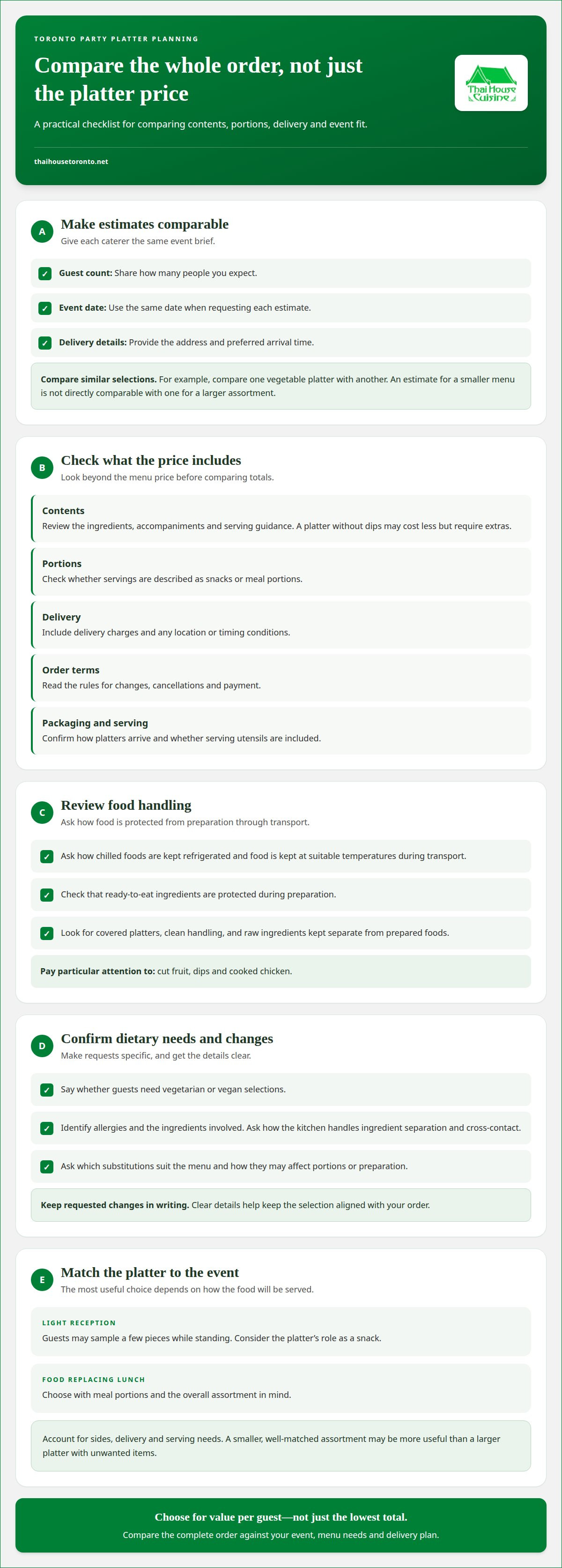
Compare the complete order, not just the price of one platter. A lower menu price may cover fewer servings or simpler ingredients. Check what each option includes, how portions are described and whether delivery is priced separately. For example, a platter without dips may cost less but require you to order extras.
Use the same event details when requesting estimates. Share the guest count, event date, delivery address and preferred arrival time. Then compare similar selections, such as one vegetable platter with another. This makes differences easier to understand. An estimate for a smaller menu is not directly comparable with one for a larger assortment.
Review these details together:
- Contents: Check the listed ingredients, accompaniments and serving guidance.
- Portions: See whether the caterer describes servings as snacks or meal portions.
- Delivery: Include delivery charges and any location or timing conditions.
- Order terms: Read the rules for changes, cancellations and payment.
- Packaging: Confirm how platters arrive and whether serving utensils are included.
Food handling matters, too. Ask how chilled foods are kept refrigerated, ready-to-eat ingredients are protected during preparation, and food is kept at suitable temperatures during transport. Look for covered platters and clean handling, with raw ingredients kept separate from prepared foods. These practices are important for items such as cut fruit, dips and cooked chicken.
Be specific about dietary needs. Tell the caterer whether guests need vegetarian or vegan selections, and identify any allergies and the ingredients involved. Ask how the kitchen handles ingredient separation and cross-contact. Requesting a nut-free platter, for example, requires more detail than simply choosing a vegetable selection.
Check how flexible the menu is without assuming every substitution is included. Replacing cheese with extra vegetables may change the portion balance or preparation. The caterer can explain which adjustments suit the menu and how they affect the order. Written details help keep your requested selection clear.
For an economical choice, focus on value per guest, not just the lowest total. A platter for a light reception differs from food intended to replace lunch. Match the selection to the event, then account for sides, delivery and serving needs. A smaller, well-matched assortment may be more useful than a larger platter with unwanted items.
For Toronto gatherings, explore local event food options as you compare menus and ordering details.
Regular and large platter sizes
“Regular” and “large” describe relative amounts, not guaranteed guest counts. A regular vegetable platter may suit a small meeting with light snacks. A large version may work better for an open-house table where guests arrive at different times. The menu’s serving guidance matters more than the size label alone.
Start by deciding what role the food will play. At a reception, guests may sample a few pieces while standing. At a working lunch, the same group may rely on platters as their main meal. A platter that works as an appetizer can feel too small for lunch. Match the selection to the event, not just the headcount.
Food type also affects how a platter serves a group. Bite-sized items are easy to take while passing, while larger pieces may need plates and utensils. A platter of cut vegetables can offer many small portions, but a tray of sandwiches may provide fewer, more substantial servings. Ask how the caterer defines a serving.
Use these steps to assess the listed size:
- Read the serving description. Look for a stated number of servings or a clear description, such as snack portions.
- Compare the contents. Check whether the platter includes dips, sides or assorted items.
- Match it to the occasion. Decide whether guests will snack, share a meal or enjoy food alongside other dishes.
- Consider the table setup. A crowded buffet may need smaller platters or several selections for easier access.
A large platter isn’t automatically the best choice for a short meeting. If attendees have a full meal elsewhere, a regular assortment may suit the break. For a longer gathering without other food, a larger quantity or additional platter types may make more sense. Let the event schedule and menu guide the amount.
Consider variety as well as volume. One large platter offers a single selection, while several smaller platters give guests more choice. A mixed gathering may benefit from separate vegetable, fruit and savoury options. Separate dishes also make it easier to see what each platter contains, especially when ingredients differ.
Presentation affects how easily guests can serve themselves. A wide platter may take up more table space than a compact tray, even if both hold similar amounts. On a narrow counter, several smaller dishes can be easier to arrange. At a spacious buffet, a large platter can create a central feature and reduce the number of dishes.
Before ordering, consider the caterer’s serving information alongside your guest count, event format and other food. If the menu describes a platter only by size, compare its contents and intended use. This gives you a more practical basis for choosing regular or large than the label alone.
Where can I easily order party platters in Canada?
In Canada, restaurants, catering companies and grocery stores can all handle group orders, but suit different event needs. A Toronto office meeting might call for lunch items, while a family reception may need snacks and varied choices. Choose an ordering channel based on the menu, delivery needs and event format.
Restaurant ordering pages often show menu items, portion descriptions and pickup or delivery options. A catering company may offer a broader event menu or help coordinate several selections. Grocery stores can be useful for familiar prepared foods and simple assortments. Compare what each route provides for your gathering.
Use this sequence to narrow the choices:
- Set the event details. Note the date, location, arrival time and approximate guest count.
- Choose the meal style. Decide whether guests need snacks, lunch or a mix of items.
- Review the menu. Compare ingredients, serving guidance and available platter sizes.
- Check delivery details. Include delivery coverage, fees, timing and drop-off instructions.
- Submit the order. Provide the final selections and any dietary notes through the available ordering method.
Online ordering can make it easier to compare menus. Look for clear item descriptions, portion information, date selection, and delivery or pickup details. A menu that distinguishes a light snack assortment from a meal selection, for example, helps you match food to the event. If a key detail is missing, use the contact method provided.
Ordering directly from a restaurant works well when its menu suits the occasion. A caterer may be a better fit when you need coordinated food across several selections. Grocery ordering may suit a gathering built around familiar prepared options. Choose the channel that fits the menu and delivery plan, not simply the first result.
For a Toronto event, delivery depends on the business’s service area and your address. Enter the complete location when prompted. A downtown venue with a reception desk may need different instructions from a home gathering. Include the recipient’s name and designated drop-off point where the form allows.
Review the full order before submitting. Check quantities, selected items, event date, address and arrival arrangements. Confirm whether the displayed total includes delivery, since fees can vary by order and location. Clear details help prevent mismatched selections and missed handoffs.
Party platter orders across Canada do not follow one universal system. Each restaurant, caterer and grocery business sets its own menu and ordering process. For easy-to-order party platters, choose an option with clear selections and a process that suits your event timing and delivery needs.
Which grocery stores and catering services offer online party platter ordering?
Online platter ordering is available through grocery store websites, restaurant menus and catering pages. Each channel offers a different way to browse selections and submit event details. A grocery store may organize options by department, such as deli, bakery or prepared foods. A catering page may group items by event type or serving style.
Start by identifying the food your event needs. For a workplace break, a grocery deli menu might offer ready-to-serve savoury items. For a reception with several courses, a caterer’s event menu may provide broader choices. A restaurant ordering page can suit an event built around one cuisine or menu.
Online systems commonly guide customers through a sequence:
- Browse selections. Review platter descriptions, ingredients and available sizes.
- Choose quantities. Add the required selections to the order.
- Enter event details. Provide the date, delivery address and requested timing.
- Review the order. Check items, quantities, delivery information and the displayed total.
- Submit the request. Follow the page’s instructions for payment or order confirmation.
Some ordering pages let you select a delivery date during checkout. Others direct event orders through a separate catering form. For example, a grocery site might use its regular cart for prepared foods, while its catering department uses an event-order form. Follow the page’s instructions to choose the right route.
Compare online ordering features, not just food photographs. Clear descriptions distinguish a snack platter from a meal-style assortment. Ingredient details help identify selections for vegetarian guests. Serving information, delivery terms and change policies also make an order easier to plan.
Delivery details vary by business and address. An online form may request a postal code to show delivery choices, while another page may list pickup and delivery separately. For a Toronto office, include the building name, suite or reception instructions in the designated fields. These details give the delivery team a clearer handoff plan.
Before submitting, review the event date and delivery window. Make sure every selected platter appears in the cart, especially after changing quantities. Read any notes about substitutions or order changes. Save the confirmation or order number so you can refer to the details later.
Online ordering works best when the menu, portions and delivery steps are easy to understand. For an event centred on Thai cuisine, use Thai food ordering options to explore a local restaurant’s menu and service details.
Look for grocery websites with deli, bakery or prepared-food ordering, and catering pages with event menus. Restaurant ordering pages may also offer platters for events.
Thai House Cuisine: Takeout and Delivery Orders
Thai House Cuisine offers takeout, delivery and Thai food catering for events in Toronto. If you’re planning a gathering and want Thai dishes on the menu, catering is a natural option. For a smaller or more informal occasion, takeout or delivery can bring Thai food to the table without arranging a catered event.
Choose the service that fits your plans: catering for event dining, or takeout and delivery for a simpler meal. The menu also includes dine-in Thai meals and lunch specials for other occasions.
Contact Thai House Cuisine to discuss food for your event.
Make your next event feel welcoming
Let the occasion guide your choice. A relaxed gathering may call for a few shared dishes, while a structured event benefits from a menu that gives guests a clear meal to enjoy. Choose easy-to-order party platters that suit how people will gather, rather than adding food that doesn’t fit the moment. If Thai flavours would bring something special to your table, consider catering as another way to host.
Thai House Cuisine offers Thai food catering for event dining, alongside options for other occasions. Share the kind of gathering you’re planning and the food you have in mind to start planning your menu. A well-suited meal can help guests feel cared for, while leaving you more present with the people around your table.
Here’s to a gathering filled with good company and a meal worth sharing.
Frequently Asked Questions
Is party platter delivery available near me in Toronto?
Thai House Cuisine offers delivery in Toronto, including The Beaches, Danforth, Leslieville, nearby Scarborough and the East End. Delivery availability depends on the event address. For a gathering in one of these areas, Thai food delivery may suit a smaller occasion, while Thai food catering is an option for event dining. Choose based on the kind of meal and service your gathering needs.
How far in advance should you contact a caterer to order party platters for pickup or delivery?
Contact the caterer as soon as you know your event date, menu needs and pickup or delivery plan. The lead time depends on the menu, order size, preparation needs and the caterer’s schedule. A larger order or a selection requiring special preparation can take more planning than a simple assortment. Include the event address and arrival time so the caterer can plan the handoff around your gathering.


